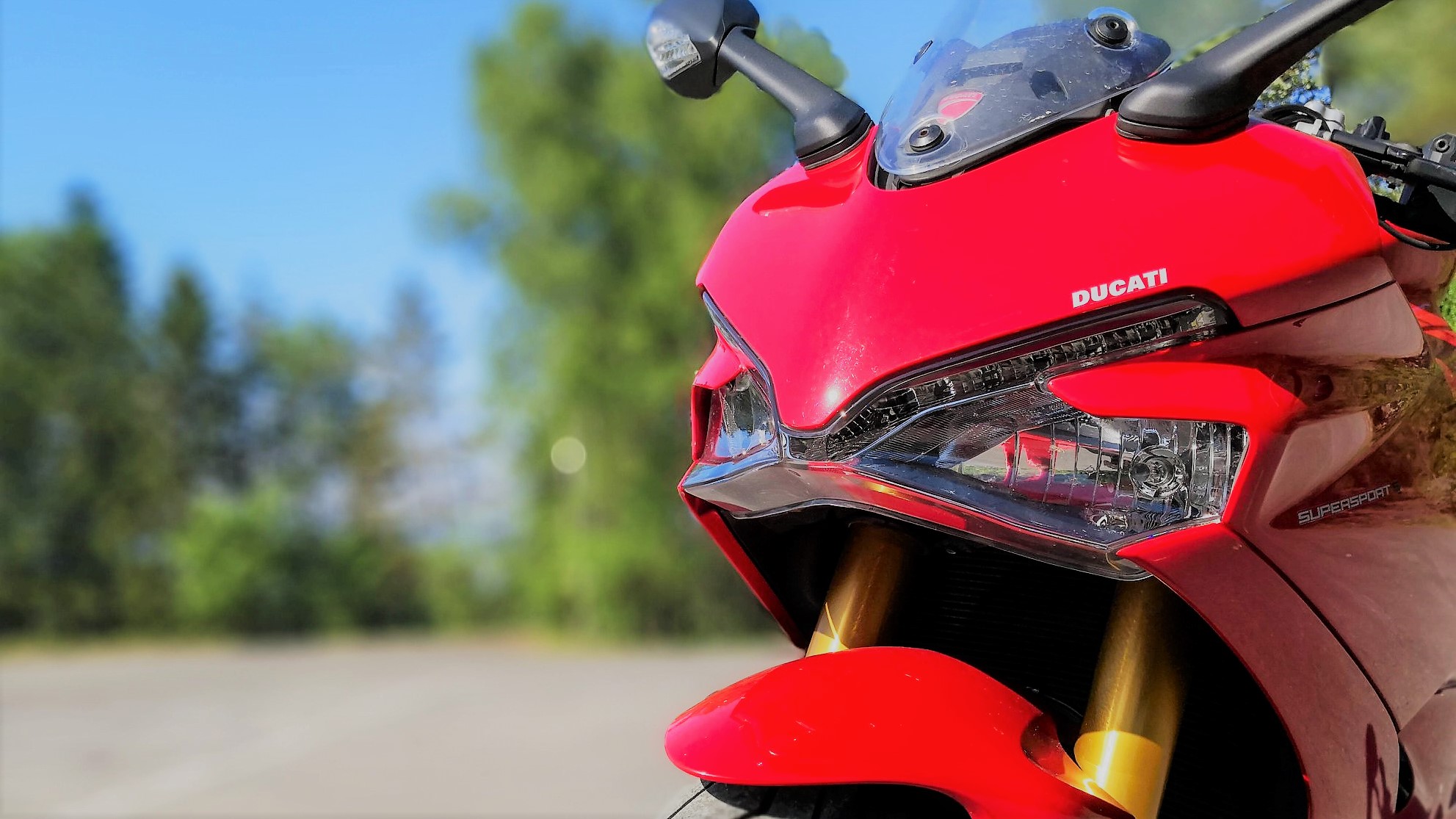
Designing Radiator Splash Guard for a Ducati SuperSport and Surprising Patents
What started as a fix for radiator grime ended up rewriting itself as an exercise in wheel wake aerodynamics. This is the long story of how reading patents changes what you think you're solving.
The radiator on a Ducati SuperSport 939 sits where every radiator on a modern sportbike sits: hung off the front of the engine, fed by whatever air the front wheel lets pass, and exposed to whatever the front wheel throws at it. On a closed-track motorcycle that exposure is academic. On a road bike that sees monsoon spray, dust storms, ditch water, and the occasional truck-tyre-flung pebble, it stops being academic very quickly.
I had already fitted aftermarket radiator guards. They protect the fins from stones. That is all they do. They are an aluminium mesh placed in front of the core, and water and grime move through them as if they were not there, which, aerodynamically, is more or less the point. The radiator is still getting splashed. The fins are still trapping road film that hardens into a baked-on crust the next time the engine reaches operating temperature. The OEM solution is, essentially, nothing. The bike was designed to look a particular way, and protecting the radiator from the front wheel was not part of that design.
So I started looking for a way to fix it without fighting the bike's reason for existing, which is to push enough air through that radiator to keep a 939cc L-twin from cooking itself in slow traffic.
The constraint that makes this hard
The problem is not "block the splash." Anyone can block the splash. A flat piece of plastic between the front wheel and the radiator solves the splash problem in five minutes and creates a much worse problem about thirty seconds after you start riding in traffic on a hot day.
The actual problem is: separate the water trajectory from the air trajectory. Water and dust are heavier than air and they have momentum. Air does not. If you can get the air to bend around an obstacle while the water keeps going straight, you have a solution. If you cannot, you have a heat-soaked engine.
That is the entire design space.
Reading what other people have already figured out
Before drawing anything, I went to the patent literature. Motorcycle manufacturers have been thinking about this problem for forty years, and most of what I would come up with on a sketchpad someone has already filed, refined, and abandoned. Twelve patents in, I had three approaches that were worth taking seriously.
Approach one: the chin scoop
The first was Piaggio and De Luca's bellypan chin scoop from IT202100002006A1. The scoop sits low and forward, ahead of the engine, and is shaped to ingest air at speed and route it upward and rearward into the engine bay. The patent itself is about aerodynamic downforce and stability. But buried in the geometry, and not mentioned anywhere in the claims, is something else.
The shape of the scoop, by virtue of where it places the airflow, also keeps road grime from collecting in the area it covers. The grime keeps going straight while the air does the bending. This is not stated as a design intention. It is a geometric byproduct. That distinction matters, because it means the inventors did not optimise for the grime problem. There is room to do that.
Approach two: vented and louvered fins
The second approach was vented and louvered fin systems, which show up in Kawasaki and Suzuki patents from the 2000s and 2010s. The principle is simple: angle a series of fins so that air enters from one side and exits the other, but the geometry forces any droplet with non-trivial mass to impact a fin instead of passing through. The droplets shed downward and out. The air, having much less momentum, follows the curve.
It is the same principle as a marine engine intake, scaled down and bolted to a motorcycle fairing. The Suzuki implementations are particularly clean.
Approach three: Bernoulli suction
The third was Yamaha's JP2024104470A, which is much weirder and probably much harder to manufacture. It uses a Bernoulli-effect suction guide member that creates a low-pressure region behind a curved deflector. The pressure differential pulls air through but actively rejects water. It is the most elegant of the three, and almost certainly the least practical for a one-off retrofit on an SS939.
There were others: BMW's turbine-blade lamellae with an explicit splash drain (WO2005070749A1), Aprilia and Piaggio's air conveyor that wraps the front wheel (US11890924B2), and several Japanese filings. But those three were the framework.
The synthesis
The plan, after all of that, was to combine the first two approaches and ignore the third.
A chin scoop in the De Luca style would handle the bulk of the dust and the larger splash, because it would route the airflow on a path that the water and grit could not follow. Above it, the body fairing would carry a louvered insert that handled finer spray and the splash that the scoop did not catch.
Both elements would live on the body fairing rather than on the front fender, which was a deliberate choice. The fender moves with the fork. The body fairing does not. Putting active surfaces on both means risking a collision between them under hard braking with full suspension compression, which is exactly the moment you do not want to discover the geometry was tight.
The radiator guards stay. They are doing the one job they are good at. Everything else is upstream of them.
This part of the project I had reasoned about cleanly. I knew what each element did. I knew why the combination was redundant in a good way: if the scoop missed something, the louvers would catch it, and vice versa. The patent literature had given me the vocabulary and the precedent. I was ready to move to CAD.
And then the project changed shape.
The detour
Somewhere in the middle of reading the Aprilia air-conveyor patent, the one that wraps the front wheel, I started thinking about what a wrap-around fender would actually do, aerodynamically, beyond just blocking water. The patent is about routing air, not about splash. But on a motorcycle the front wheel is a rotating bluff body sitting in the airstream, and rotating bluff bodies have wakes. The wake is turbulent. The turbulent wake is what the radiator is sitting in.
This is well-established in car aerodynamics. Rotating wheels account for somewhere north of fifty percent of the drag of an open-wheel vehicle, which is why every modern car has some form of wheel-arch liner or air curtain shaping the flow around the front tyre. On motorcycles the picture is less studied in production-bike terms, but MotoGP teams have been quietly playing with extended front fenders for years for exactly this reason. It is not the splash. It is the wake.
So the question stopped being "how do I protect the radiator from water" and became "how do I deliver cleaner air to the radiator." Which sounds like the same question and is not.
Protecting from water is a defensive design: you build a barrier and you accept whatever airflow penalty comes with it.
Delivering cleaner air is an offensive design: you reshape the flow field so the radiator gets a better feed than it does from the factory, and the splash protection is something you collect along the way.
An extended wrap-around fender, in this framing, is not a fender at all. It is a wheel wake suppressor. It happens to also stop water from being flung into the radiator, but its primary job is to take a turbulent rotating-cylinder wake and replace it with something closer to attached flow before that air hits the radiator face. Cleaner air, lower drag, less splash. Three benefits, one part.
I did not expect this when I started. I went into the patent search looking for splash guards and came out with what is essentially a small piece of streamlining philosophy. This is, in retrospect, what patent literature is for: not just the claims, but the framing the inventors did not bother to put in the claims because it was not the point of their particular filing.
What I am still working through
The wrap-around fender concept is not free. Three problems are open.
Clearance
The front fender on an SS939 moves with the fork. Under full compression, on heavy braking, it moves a lot, and not just vertically; it moves rotationally because the fork itself rotates with the steering. An extended fender has to clear the fairing, the brake calipers, the fork lowers, and the engine cradle at every combination of steering angle and suspension travel. This is something I cannot fully reason about from drawings. It needs to be measured on the bike, with the fork compressed and the bars at full lock, in every meaningful combination.
Drainage
The chin scoop, by design, has a low point. At highway speeds, the airflow keeps that low point dry by pulling the water through. At low speeds and at standstill, it does not. Anyone who has ridden a sportbike with a bellypan in a Mumbai monsoon knows what a low point that does not drain looks like after twenty minutes of traffic.
The current candidate solution is a slot in the bellypan floor with a small rubber flap valve: the flap opens under the weight of accumulated water and closes against the upward pressure of incoming airflow at speed. It is a check valve made of rubber, essentially. Whether it works in practice is a question I will not be able to answer until the part exists.
CFD
None of this is real until it has been simulated. The whole reason for doing the patent reading was to avoid drawing twelve iterations of a shape that someone has already proven does not work. But knowing that a shape works in someone else's patent does not tell me that the combination of three shapes works on my motorcycle, with my radiator position, with my fairing geometry. Simulation is the only way to find out short of fabricating each version and riding it.
What this project is actually about
I started this thinking I was building a splash guard. I am now building something closer to a small flow management system for the front of the motorcycle, which happens to address splash as one of its outputs. The patent literature did not just give me solutions. It gave me a different way of describing the problem, and the new description is much more useful than the original one.
There is a specific kind of clarity that comes from reading a lot of patents on the same topic. Each individual filing is narrow, claim-bounded, focused on one thing. But you read twelve of them and a shape emerges. You start seeing what the manufacturers collectively understood about the problem and what they collectively missed.
- Piaggio's chin scoop has a grime-prevention side effect they did not write about.
- Yamaha's Bernoulli geometry is elegant beyond the use case it was filed for.
- The Aprilia wheel-wrap patent points at something, wheel wake management, that is much more important than the patent itself treats it as.
The OEM does not solve every problem the OEM created. Some of those problems are oversights and some are deliberate trade-offs against weight or cost or styling. The interesting question is which is which, and the patent literature is one of the few places that tells you, because the manufacturers themselves were thinking about it, even when they decided not to ship the solution.
The build is not done. The CFD is not done. The clearance checks are pending. But the design direction is settled now in a way it was not three months ago, and that shift came not from sketching but from reading. That is worth remembering the next time I think I know what a project is about before I have looked at the literature.